Tailor Shop Management in Kenya: Measurements, Deposits, Job Sheets and School Uniform Contracts
How to run a profitable tailor shop in Kenya — storing customer measurements, deposit systems, job sheet workflows, material vs labour pricing, school uniform contracts, and the POS workflow built for service businesses.
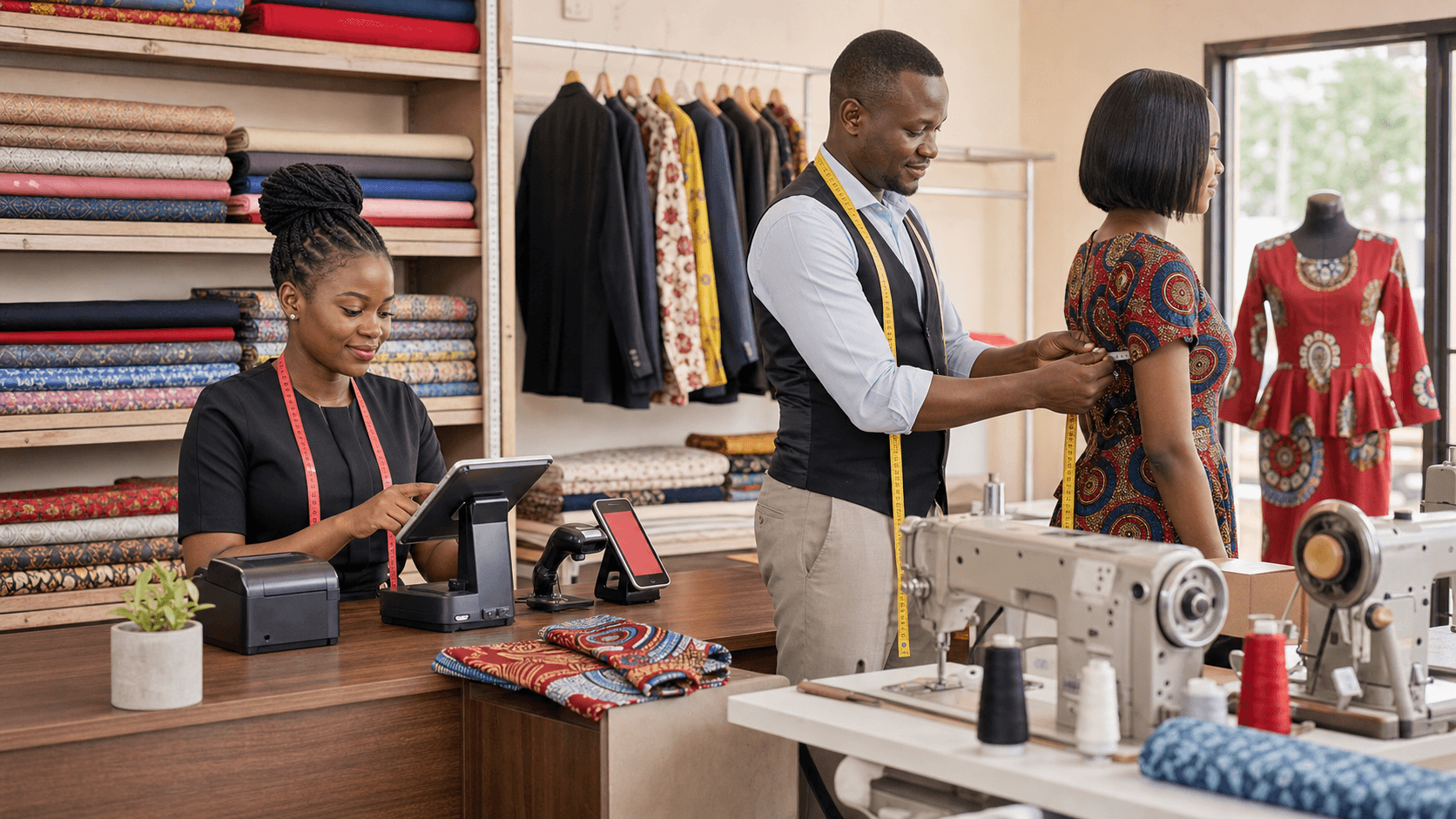
A tailor shop in Kenya is not a retail shop — it is a service business where every customer is a recurring relationship, every order is a job sheet with measurements and a deadline, and every sale is split between material and labour with very different margins on each. Run it like a duka and you lose track of who owes what for which dress; run it like a project workshop with proper records, and you turn a single-machine shop into a multi-tailor operation with school-uniform contracts that anchor your annual revenue.
This guide is for tailors and tailoring shops across Kenya — bespoke dressmakers, school-uniform specialists, alteration shops, the mixed-trade tailors common in every market town, and the home-based seamstresses building toward a proper workshop.
The Customer Measurement Database
The single most valuable asset a tailor can build is a measurement database. A customer whose measurements you already have is a customer who can order over WhatsApp without coming in; a customer whose measurements you have to re-take every time is a customer who will defect to a competitor when it gets inconvenient.
What to Capture, Once, Per Customer
- Identity: name, phone number, photo (optional — useful for repeat work years later).
- Body measurements: chest, waist, hip, shoulder, sleeve, neck, inseam, outseam, thigh, knee, ankle. For women add bust, under-bust, dress length to knee/calf/floor.
- Preferences: usual fit (loose, tailored, slim), shoulder fit (natural, structured), trouser break (none, slight, full).
- Date measured: bodies change. Re-measure annually or when the customer flags weight change.
The POS customer profile should hold all of this. Apps designed for service businesses let you attach custom fields per customer — measurements, preferences, fabric allergies, anything operationally relevant.
Why Measurements Should Live in the POS, Not a Notebook
A paper measurement book gets:
- Lost (the most common cause of "I have to take your measurements again, sorry").
- Smudged after washing or a tea spill.
- Hard to search when 600 customers are in it and one calls saying "I'm Mary, you made me a dress two years ago."
A digital record solves all three and lets you back up your most valuable asset to the cloud. If your phone or shop burns down, the customer book survives.
The Job Sheet Workflow
Every tailoring order is a job, not a sale. A job has more state than a retail transaction:
- Quote / discussion. Customer describes what they want; tailor explains options and prices.
- Material choice. From the customer (they brought fabric) or from your stock.
- Measurement. New or pulled from history.
- Design notes. Sleeve type, collar style, neckline, length, pockets — written down with sketches if needed.
- Deposit taken. Typically 50% to start work.
- Job sheet issued. Customer gets a slip; the shop logs the job.
- Work in progress. Cutting, stitching, finishing.
- Fitting (if bespoke). Customer comes back for a try-on; tailor marks adjustments.
- Final adjustment and finishing.
- Pickup, balance paid, garment handed over. Customer signs the job sheet.
A POS that doesn't understand "in progress" between "started" and "completed" is not built for service businesses. Look for one with job sheet status tracking.
The Deposit System: Where Cash Flow Lives
Tailor work without deposits is a gamble. The customer disappears mid-job, you have already bought thread and spent two days cutting and stitching, and you cannot recover. The 50/50 deposit-and-balance system is industry standard for a reason:
- 50% deposit at order placement — covers your material and initial labour. The customer has skin in the game.
- 50% balance at pickup — paid before the garment leaves the shop, no exceptions.
- Adjustments and re-fitting — included in the original price; not a separate charge unless the customer changes the design after work has started.
The POS should record deposits as separate transactions linked to the job sheet, with the balance owing automatically calculated and visible to staff. When the customer comes for pickup, the cashier sees "Balance: KES 2,500" without doing mental math.
Material vs Labour: Two Margins, One Receipt
A tailored shirt's price has two components: the fabric you used (or charged for if the customer brought their own) and the labour to design, cut, stitch and finish. These have very different margins.
- Material margin: 30-60% on fabric you sourced; 0% if the customer brought it.
- Labour margin: 70-90%. Your time is your time.
The shop that wins is the shop that knows this split. If a competitor undercuts you on a "cheap shirt at KES 1,500," you can check your records — was that loss on material price or on labour pricing? You can adjust accordingly.
The Service Pricing Sheet
Every tailor shop should have a published pricing sheet for standard services:
- Alterations: hem (KES 300-500), take in sides (KES 500-800), shorten sleeves (KES 400-700), zip replacement (KES 400-1,000).
- Standard garments: basic shirt (KES 1,500-3,000 labour), trousers (KES 2,000-4,000 labour), dress (KES 2,500-6,000 labour depending on complexity).
- Bespoke / formal: suit jacket (KES 8,000-20,000 labour), wedding dress (KES 15,000-80,000 labour).
Customers prefer clarity to bargaining. A printed price list saves you 30% of every quoting conversation.
School Uniform Contracts: The Annual Anchor
The biggest opportunity for a stable tailor shop is a school uniform contract. A school with 600 students, each ordering 2-3 uniform pieces per year, is KES 1.5-2.5 million in guaranteed annual revenue, with predictable seasonality (term openings in January, April, August).
What School Contracts Need from Your Shop
- Consistent specifications. Every uniform must match the school's pattern exactly — collar, pockets, badge placement, fabric grade. The POS should hold the school's spec sheet with photos.
- Class-by-class measurements. Take measurements once at the start of the year; the POS holds them; parents order online or by SMS for the rest of the year.
- Bulk pricing with consistent margin. The school negotiates volume — but the contract is profitable because the labour standardises (you cut 200 identical shirts in one production run, not one at a time).
- Delivery to the school or pickup window. Parents collect during specific hours; or you deliver in batches to the school office.
- Invoicing the school or the parent — depends on the model. Some schools include uniforms in fees; some leave it to parents.
Winning a single school contract can transform the economics of a tailor shop. Two or three contracts make it a different business.
Equipment, Workshop and Staff
The progression most Kenyan tailors follow:
- Single Singer or Brother machine, home-based. One tailor, one or two customers a day, mostly alterations.
- Small shop with 2-3 machines. Hire one or two apprentices; expand to bespoke work.
- Workshop with 5-10 machines. Add an overlocker, button-holer, embroidery machine. Take school contracts and bulk orders.
- Production unit with division of labour. Cutters cut, stitchers stitch, finishers finish, QC checks. This is when you scale beyond a single shop.
At each stage the POS does more work. Step 1 needs measurements and job tracking. Step 4 needs production scheduling, staff time tracking, and per-staff productivity reports.
FAQ
How long should I keep customer measurements on file?
Indefinitely, unless the customer asks for deletion. People come back five years later for the next wedding outfit. Your digital record is your competitive moat.
What deposit should I take?
50% of the total job price is standard. For repeat customers with excellent payment history, you can lower to 30%. For walk-in first-time customers, insist on the full 50%.
How do I handle customers who don't come for pickup?
Wait 30 days from the agreed pickup date. Call and text twice during that period. If still uncollected, the deposit becomes forfeited and the garment is donated, sold (if it fits another customer) or stored. Communicate this policy at the time of order so it isn't a surprise.
Can I run a tailor shop on a duka POS app?
Only if it supports custom customer fields (for measurements), job status (in progress, awaiting fitting, ready for pickup), and deposit/balance tracking. A pure-retail POS will fight you on every order.
How do I price a job a customer is bringing their own fabric?
Charge labour only — no material markup. The job sheet should note "customer-supplied fabric" so you don't accidentally charge for material you didn't supply. Your margin on the labour stays the same.
What about uniform contracts for offices, hospitals, hotels?
Same model as schools. Offices, hospitals (scrubs), hotels (housekeeping uniforms, kitchen wear) all need consistent bulk uniform supply. Network in your area; the contracts are won by reputation, not advertising.
The Bottom Line
A tailor shop is a service business with a stock cupboard, not a stock business with a sewing machine. The customers, the measurements, the job sheets, and the deposits are the actual operating assets. A POS that holds all of these — searchable, backed up to the cloud, accessible from your phone — is what turns a one-machine shop into a multi-tailor workshop with school contracts that anchor the year. The machines do the visible work; the records do the invisible work that makes the business durable.
Ready to try DukaSale?
Free POS app for Kenyan dukas. Track sales, inventory, M-Pesa payments, and customer credit — all offline.
Download Free