Shoes & Accessories Shop POS in Kenya: Size Matrix, Counterfeit Risk and Add-On Margins
How to run a shoes and accessories shop in Kenya — managing size and width variants, spotting counterfeits, returns for fit, accessories as add-on margin, and the supplier discipline that keeps a fashion-footwear shop profitable.
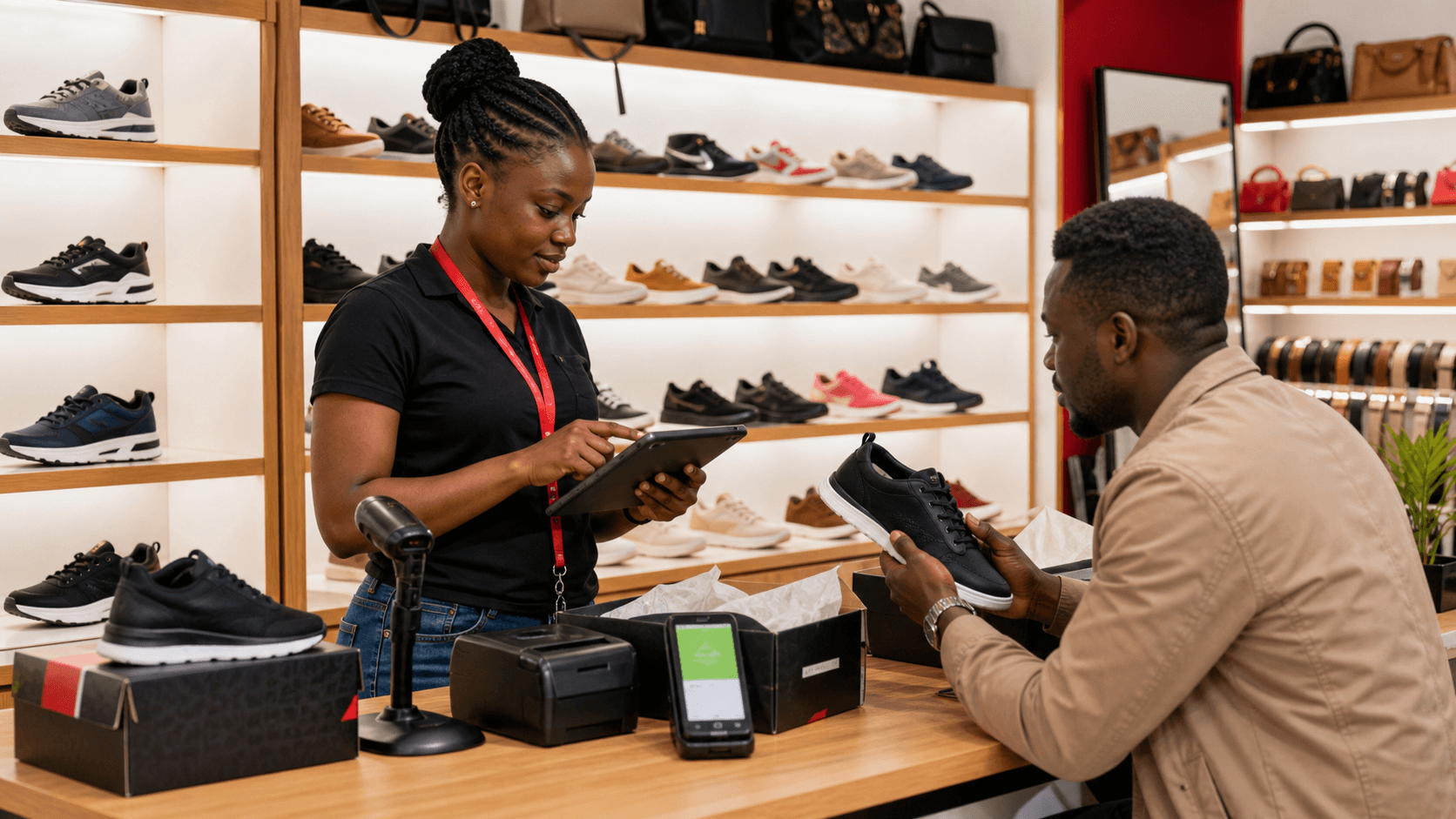
A shoes and accessories shop in Kenya carries more variants per square metre than almost any other retail category — a single shoe model in 8 sizes × 3 colours × 2 widths is 48 SKUs, and a small shop easily stocks 40+ models. Get the size matrix wrong and you lose a sale every time a customer asks for a 41 in tan and you only have it in black. Get the counterfeit story wrong and you face KEBS, customer disputes, or worse. This guide is for the shoe and accessories shops along Moi Avenue Nairobi, Biashara Street, Nyali Centre Mombasa, Mega City Kisumu, and every county town with a fashion-footwear trade.
The Size Matrix: Why Footwear Is Brutal on Stock Planning
Clothing variants are forgiving — a size M shirt and a size L shirt are close enough that a customer might buy either. Footwear is unforgiving. A size 42 customer cannot buy a 41 and "make it work." If you don't have the exact size, you don't have a sale.
What Stocking by Size Actually Looks Like
Most shoe models sell in a curve, not evenly across sizes. The typical sell-through pattern for women's footwear in Kenya:
- Size 36-37: 15% of demand each.
- Size 38-39: 25% of demand each (the peak).
- Size 40-41: 12% of demand each.
- Size 35 and 42+: 3-5% of demand each.
For men, the curve shifts: peak demand is 42-44, tails at 39 and 47+. Your buy quantities per size should match this curve, not be evenly spread. The POS sales-by-size report tells you the actual curve in your specific shop after a few months of data.
The Width Variable
European and American brands often come in standard, narrow and wide widths. Most Kenyan shoe shops simplify to one width per model, but high-end shops carry width variants for customers with hard-to-fit feet. These customers are loyal and recurring — if you stock them, they stay.
The Counterfeit Problem: Brand Footwear and KEBS
Kenya's shoe market is a counterfeit minefield. "Nike," "Adidas," "Puma," "Crocs," "Bata" knock-offs flood in through unofficial channels — sometimes hard to tell from genuine at the receiving dock. As a licensed retailer your obligations:
- Buy only from authorised distributors for branded footwear. Bata Kenya, official Nike Kenya importers, Adidas Kenya distributors. A "very good price" from a street importer is almost certainly knock-off.
- Disclose if you sell grey-market or unbranded. An honest "import — no manufacturer warranty" line on the receipt is legal and ethical. Selling an "Adidas" knock-off as genuine is fraud.
- KEBS standardisation mark — imported branded footwear should have it. Random-check your stock at receiving.
- Anti-Counterfeit Authority can raid and seize counterfeit stock. The damage to your licence and reputation is total.
Returns for Fit: The Footwear Reality
Shoes are the highest-return category in fashion retail because fit is more critical and harder to assess in-store. Industry data shows 15-25% of footwear sales come back for exchange or refund. Your policy must accommodate this without absorbing the cost.
The Fitting Discipline
- Always insist on trying on both shoes. Customers who buy without trying are the ones who return. Even if they "know their size," brands fit differently.
- Walk a few steps in the store. A heel that feels fine standing still rubs after 50 metres.
- Use the right sock or stocking. Trying dress shoes barefoot doesn't tell you anything.
- Mark each pair tried. Some customers will "browse" by trying on 10 pairs and buying nothing. That's fine, but staff should know.
The Return Policy
- 7-day exchange with unworn condition (no outdoor wear marks), tag, box, and receipt — for size or colour.
- No returns on sale items.
- Manufacturer defects (sole separating, stitching coming apart) within 30 days — replace or refund.
- No returns after 30 days, ever.
The Accessories Multiplier: How Add-Ons Save Your Margin
Shoes typically run 25-40% gross margin. Accessories — belts, wallets, handbags, sunglasses, watches — run 50-70%. Customers who buy one item often buy a second if prompted. The well-trained shop turns every shoe sale into a potential bag or belt sale.
The Practical Cross-Sell Flow
- Customer chooses shoes. Sale is going through.
- Staff asks: "These look great. Would you like a matching belt to go with them?" or "Do you have a bag for this outfit yet?"
- Show two or three options at relevant price points. Don't push — offer.
- If they buy, the POS rings up the second item; the average ticket grows from KES 4,500 to KES 6,500.
Your POS sales report by category should track this: what percentage of customers who buy shoes also buy an accessory? Aim for 25-40%. The shop with discipline doubles its accessories sell-through and meaningfully grows total margin.
Supplier Discipline in a Tight-Margin Trade
Most Kenyan shoe shops buy from a mix of:
- Local manufacturers — Bata Kenya (genuine), small leather workshops.
- Official distributors — for international brands cleared through KEBS.
- Direct imports — China, Turkey, Italy. Requires customs and KEBS knowledge.
- Gikomba and Eastleigh wholesalers — for budget lines.
The POS supplier ledger should track each supplier's lead time, return rates, and your actual margin on their products. A "cheap" supplier with a 12% return rate is more expensive than a "premium" one with 2%.
Seasonality in Kenyan Footwear
- December-January — peak. Holiday gifting, end-of-year parties, weddings.
- April school holidays — children's shoes and back-to-school adjacent buying.
- June-August (cool months) — closed shoes, boots, warmer footwear.
- October-November — pre-holiday buying ramp.
- February-March — slowest months. Mark down winter stock aggressively here.
FAQ
How do I detect counterfeit shoes at receiving?
Buy only from authorised distributors. Check the box: genuine boxes are well-printed with consistent fonts, the brand logo on the shoe matches reference photos, the stitching is even, the smell is leather (not chemical), and the price is rationally above wholesale. If the price seems too good, it almost certainly is.
Should I sell unbranded shoes alongside branded ones?
Yes — most Kenyan shoe shops do. Just keep them clearly separate in the layout and on receipts: "Brand X — KES 5,500" and "Casual Slip-on — KES 1,800" are honest pricing for honest products. Where shops get into trouble is selling unbranded shoes labelled as brand-name knock-offs.
How many size variants should I stock per model?
The match-the-demand-curve rule: heavy in your peak sizes (38-39 for women, 42-44 for men) and lighter in the tails. As a starter rule, stock 4 pairs of peak sizes and 1-2 pairs of edge sizes per model.
What's a realistic gross margin on shoes?
25-35% on branded footwear, 40-55% on unbranded and locally manufactured, 50-70% on accessories. Your blended margin should sit at 35-45% for a healthy shop.
Can I integrate fitting service (sole repair, shoe shine) into a shoe POS?
Yes — set them up as service SKUs in the POS with labour pricing. A customer who comes for a sole repair often browses the new stock; the service is a customer-acquisition tool, not just a side revenue.
The Bottom Line
A shoes and accessories shop in Kenya is a high-variant, returns-heavy, counterfeit-vulnerable trade where the margin lives in the add-on sale and the customer relationship. A POS that handles a true size-colour-width matrix, separates branded from unbranded inventory cleanly, tracks return rates per supplier, and prompts cross-sells at the till is the operational backbone of a shop that grows past one location. Build it once, train the team, and watch the average ticket — and the repeat-customer count — climb.
Ready to try DukaSale?
Free POS app for Kenyan dukas. Track sales, inventory, M-Pesa payments, and customer credit — all offline.
Download Free