Running a Restaurant in Kenya: Menu, KOT Printing, Table Management and Shift Discipline
How to run a profitable restaurant in Kenya — designing a sellable menu with modifiers, kitchen order ticket (KOT) printing, table and tab management, course timing, shift discipline, and the POS workflow that ties the floor and the kitchen together.
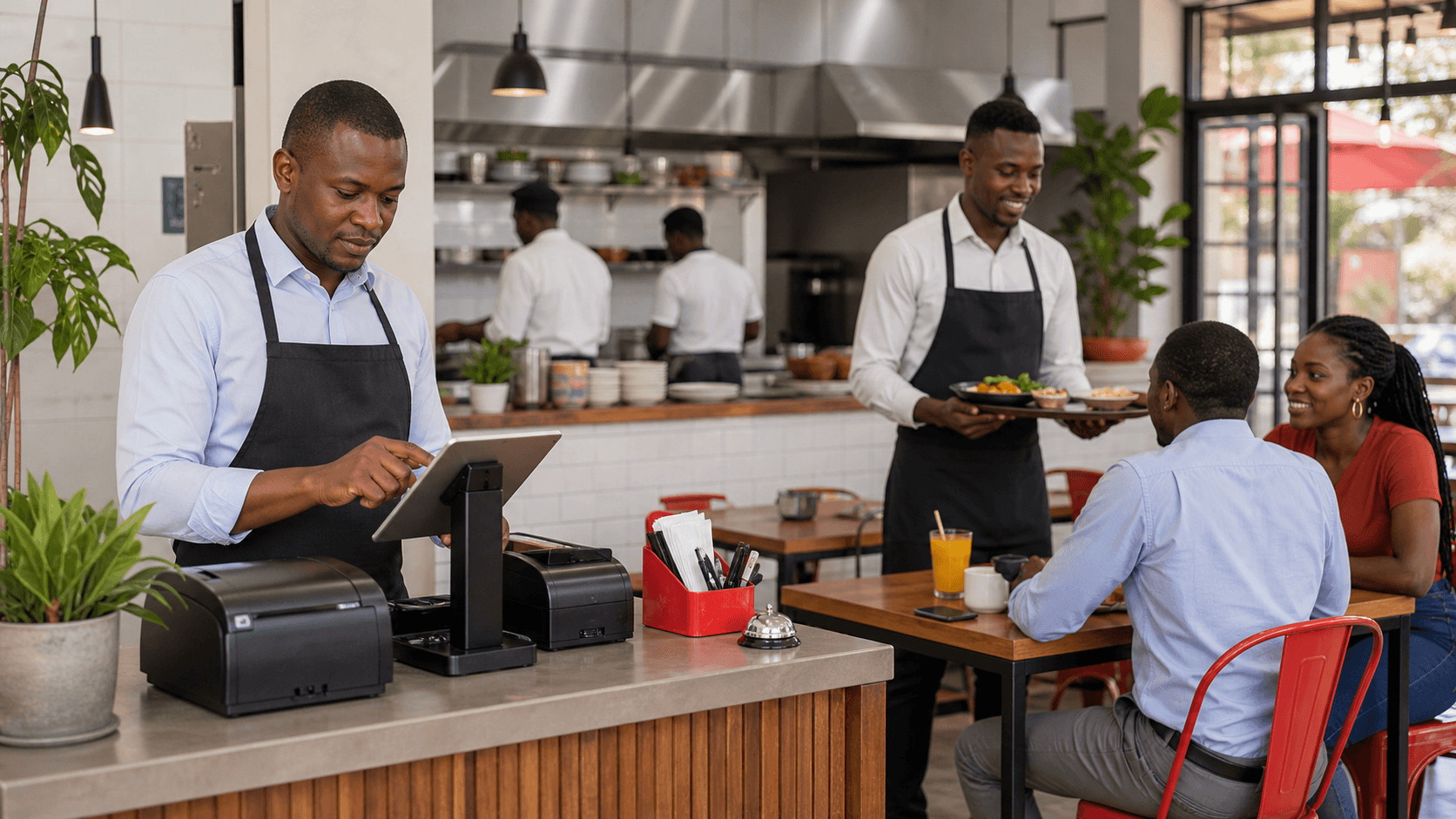
A restaurant in Kenya is not a shop — it is two operations running in parallel: the front of house taking orders, managing tables and collecting payment, and the back of house cooking, plating and timing dishes for tables that all want their food at the same time. The POS is the bridge between them. When it works, the floor is calm, the kitchen knows what is coming, and the customer's main course arrives 15 minutes after the starter — not 45 minutes. When it does not work, you lose customers in queues, send dishes to the wrong tables, and bleed margin to comp meals.
This guide is for restaurants, cafés and quick-service spots across Kenya — from the corner café in Westlands to the multi-floor restaurant in Kilimani, from the local nyama choma joint to the hotel-adjacent fine dining room.
Designing a Menu That Actually Sells
The first operational decision is the menu structure. A menu with 80 items is harder to cook, slower to learn, and bleeds inventory cost. A focused 25–40 item menu sells better and trains faster.
The Menu Structure That Works
- Sections — starters, salads, mains, sides, desserts, drinks. The POS organises the screen the same way the menu reads.
- Categories within sections — under "mains" you might have grills, pastas, stews, vegetarian. This is how the kitchen brigade splits responsibilities and how the POS routes Kitchen Order Tickets (KOTs) to the right station.
- Modifiers per item — "no onions," "extra cheese," "well done," "with chips not rice." The POS stores these and prints them on the KOT so the chef cooks the correct version.
- Price tiers when needed — a 250g steak and a 350g steak are two variants of the same dish; the modifier or variant logic in the POS handles them as separate price points.
Kitchen Order Tickets: The Print That Keeps the Kitchen Running
Every order needs to reach the kitchen in a form they can act on. The KOT (Kitchen Order Ticket) is the printed slip that tells the brigade what to cook, in what quantity, for which table.
What a Good KOT Workflow Looks Like
- Waiter takes the order on the POS at the table or on a tablet.
- The order is split by station: grill items print at the grill station, salad items at the cold station, drinks at the bar.
- Each station's KOT shows the table number, the item with modifiers, and the order time.
- When a dish is plated and ready, the kitchen marks it on their screen (or rings a bell, depending on workflow).
- The waiter sees the table's order status on the POS and collects the food when ready.
This is the operational core of any restaurant POS. A till that does not split KOTs by station is a till that forces a single chef to make every dish in sequence — fine for a 4-table café, fatal for a 30-cover restaurant.
Table and Tab Management
Restaurants do not ring up sales like a duka — they open tabs. A customer arrives, sits at table 7, orders starters and drinks. Later they add mains. Later still, they order dessert and coffee. Through all of this, the bill accumulates on table 7's tab. The POS workflow:
- Open table — the waiter taps the table on the floor plan view and starts adding items.
- Send to kitchen — items go to KOT print immediately or in a batch when the waiter is ready.
- Transfer table — guests want to move to a different table; the POS moves the open tab.
- Split bill — the group wants to pay separately. The POS lets the waiter split by item, by share, or by guest.
- Close the tab — final bill is presented, payment is taken (cash, M-Pesa STK push, card), table is freed.
The Tip and Service Charge Discipline
In Kenya, service charge of 10% is common in mid-market and premium restaurants, baked into the bill. Tips on top are voluntary. The POS should:
- Show service charge as a separate line on the bill (legally required for VAT calculation).
- Track tips by waiter for end-of-shift distribution.
- Never count tips as restaurant revenue (they belong to staff, accounting-wise).
Course Timing: The Hardest Operational Skill
A good restaurant gets the starter to the table within 10 minutes of sitting, the main 15 minutes after the starter is finished, dessert within 10 minutes of clearing mains. A bad restaurant sends mains while the customer is still eating the starter, or makes them wait 35 minutes between dishes.
How the POS Helps
- Course flagging — when the waiter sends the order, they mark starters, mains and desserts. The kitchen fires starters immediately, holds mains until starter clear, fires desserts on request.
- Table status — the floor manager sees which tables have been served starters but not mains, which are awaiting desserts, which are ready for the bill.
- Time-at-stage tracking — how long is each table sitting before each course arrives? A table waiting 30 minutes for a main is a problem the manager needs to fix before the customer complains.
VAT, eTIMS and Catering Levy
Kenyan restaurants face a layered tax stack:
- VAT at 16% on most prepared food and drinks once you are above the KES 5 million turnover threshold.
- Catering Levy at 2% on bills, payable to the Tourism Fund (for restaurants serving food). Applied to the food portion of the bill, separately from VAT.
- KRA eTIMS — the Electronic Tax Invoice Management System. Every receipt must eventually carry a KRA control number. The POS handles this if it is eTIMS-integrated.
- Service charge — not a tax, but treated separately. It appears on the bill, but VAT applies to it like any service.
A typical receipt line breakdown:
- Food and drink subtotal: KES 4,000.
- Service charge (10%): KES 400.
- Catering levy (2%): KES 80.
- VAT (16% on subtotal + service): KES 704.
- Total payable: KES 5,184.
Shift Management
A restaurant runs on shifts. Lunch (11am–3pm), dinner (6pm–10pm or later), with breakfast and brunch for some venues. Each shift has its own opening procedures, mid-shift handoffs, closing reconciliation.
- Each waiter logs in with a PIN. Their sales and tips are tracked individually.
- Cash drops — every couple of hours during busy service, large notes leave the front-of-house drawer and go to the safe. Reduces theft and till exposure.
- Comps and discounts above a threshold require a manager PIN. A waiter cannot decide to give a 50% discount on a KES 8,000 bill; the manager approves and the system records it.
- End-of-shift Z-report per till — sales total, cash count, M-Pesa total, card total, comps, voids. The waiter signs; the manager counter-signs.
FAQ
Do I need printers at every kitchen station?
Yes — every distinct cooking station (grill, cold/salad, bar, dessert) needs its own KOT printer or a screen showing only its incoming orders. Routing all kitchen orders to one printer means the chef sorts by hand, which slows service.
Can I run a restaurant on a phone POS?
For a 4–6 table café, yes — the same Android phone that runs a duka POS can run a basic restaurant POS. For 10+ tables, multiple servers or any meaningful kitchen brigade, you need a browser-based POS on a tablet or terminal that supports KOT printing, floor plans and table management.
How long should a turn (table seating to bill close) take?
Casual dining: 60–75 minutes per turn. Mid-market: 75–90 minutes. Fine dining: 100–150 minutes. The POS table-status view tells you average turn time by day of week, which informs your reservation policy.
What licences does a restaurant need in Kenya?
Single business permit from your county, KRA PIN, public health certificate (annual inspection), food handlers' certificates for every kitchen and service staff member, Tourism Fund registration if applicable, and a liquor licence if you serve alcohol.
How do I handle a customer dispute over a charge?
The POS audit log shows every item sent to the kitchen, when, and by which waiter. If a customer disputes "we didn't order that," the system tells you whether the item was sent, kitchen prepared it, and the waiter delivered it. The argument is brief because the data is clear.
The Bottom Line
A restaurant's profitability lives in the gap between operational chaos and operational rhythm. A POS that handles menu modifiers, splits KOTs across stations, manages tables and tabs, tracks course timing, supports per-waiter PINs and shift reconciliation is what turns a busy night from a stressful blur into a profitable rhythm. The food matters, but the system around the food is what scales the kitchen from one floor to a small chain.
Ready to try DukaSale?
Free POS app for Kenyan dukas. Track sales, inventory, M-Pesa payments, and customer credit — all offline.
Download Free