Running a Clothing Boutique in Kenya: Size & Colour Variants, Seasons and Returns
How to run a profitable clothing boutique in Kenya — managing size and colour variants, seasonal collections, Instagram-driven sales, returns and exchanges, and the margin discipline that keeps mid-market fashion alive.
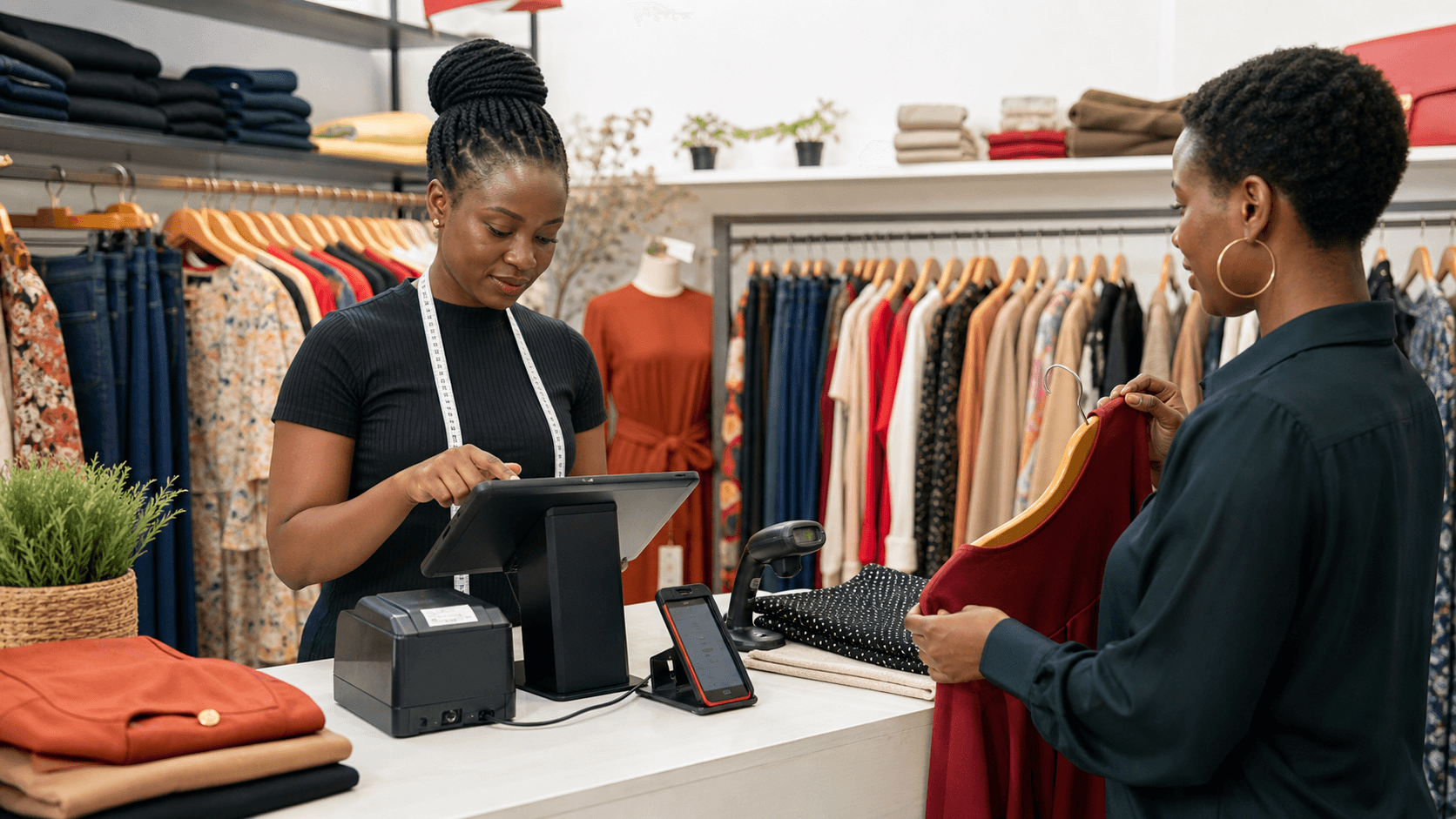
A clothing boutique in Kenya lives or dies on three numbers: how many size-colour variants you can stock without drowning in slow movers, how much of last season ends up on the markdown rail, and how clean your returns policy is when a customer wants a refund three weeks after they bought a dress. The boutiques that survive — in Westgate, Two Rivers, Sarit, Yaya Centre, Karen Square and the high streets of Mombasa and Kisumu — treat each garment as a SKU with three or four dimensions, not a single price tag.
This guide is for independent boutique owners selling mid-market and premium clothing in Kenya — imported, locally manufactured, or a mix. It walks through the operational realities that don't appear in any "fashion business" book written for European markets.
The Variant Matrix: Why One SKU Is Never Enough
A dress is not a SKU. A "Floral Maxi Dress" available in S/M/L/XL across three colours (black, navy, red) is twelve SKUs — twelve separate things to count, sell, restock, mark down and report on. Treating it as one product is the most common mistake in Kenyan boutiques, and it is the root of almost every stock disaster downstream.
How to Set Up Variants Properly
Every garment in your boutique should be modelled as a parent style with child variants:
- Parent style: "Floral Maxi Dress — KES 4,500" with one image, description and base price.
- Variants: each unique combination of size and colour, with its own stock count and barcode.
- Variant-level pricing when needed: the XL might cost KES 4,800 because of fabric usage, or the red might be a clearance line at KES 3,000.
At the till, the cashier scans a tag or selects size + colour from the parent, and the POS records the sale against the specific variant. The stock report shows you that S/black sells out in two weeks while XL/red sits unsold for four months. Without variant-level tracking, all you see is "Floral Maxi Dress — 5 sold, 7 left" — useless for reorder decisions.
Seasonal Buying: The Margin Discipline
Fashion is seasonal. Boutiques that buy without a season plan end up with a rack of unsellable winter coats in February and no light dresses for August. Kenya's climate means seasons matter less than weather and event cycles — but they still matter:
- School holidays (April, August, December) — uniform-adjacent items, casual wear for travel.
- Wedding season (December, April, July) — formal wear, occasion dresses, men's suits.
- End-of-year — gifting, party wear, work Christmas events.
- Cooler months (June-August in Nairobi) — light jackets, sweaters, warmer fabrics.
The 70-20-10 Rule for Stock
A well-run boutique splits its buy across three time-horizons:
- 70% core stock — staples that sell year-round (basic jeans, plain T-shirts, classic dresses).
- 20% seasonal — pieces aligned to the current season's events.
- 10% trend — bold or experimental pieces that test customer appetite.
Your POS sales report by category tells you whether you have the mix right. If your "trend" pieces never move, you are over-buying experiments. If your "core" sells out constantly, you are under-stocking the workhorses.
The Markdown Cycle: How to Move Slow Stock
Every boutique has slow movers. The art is recognising them fast and clearing them before they tie up cash. The standard fashion-retail markdown cycle:
- Week 1-4 at full price. If a style is not selling at all by week 4, something is wrong — fit, price, or visibility.
- Week 5-8 at 20% off. Move it to a promotional rack near the entrance. If still nothing, the price was not the problem.
- Week 9-12 at 40% off. Aggressive clearance. Goal is to recover the cost and free the rail space.
- Week 13+ at 50-70% off. Either move it, give it to staff, or donate. Holding stock past 90 days is a real loss.
The POS should let you set a discount on specific variants without changing the parent style price. The discount appears at the till automatically when that variant is scanned.
Instagram, WhatsApp and the Phone-First Customer
Most Kenyan boutique sales today start on a phone. A customer sees a piece on Instagram, DMs the boutique, asks for the size, gets a price, sends M-Pesa, the piece is delivered or picked up. The boutiques that win this game treat their POS and their Instagram as one system:
- Every new arrival is photographed and listed on Instagram within 24 hours of stocking.
- Each photo links back to a specific SKU in the POS — so when a customer says "the green dress in your story yesterday," the team finds the exact variant fast.
- WhatsApp orders create draft sales in the POS that close when the customer pays via M-Pesa.
- Delivery is scheduled through the POS with the customer's location, contact, and a courier (Sendy, Glovo, in-house rider).
This is the practical answer to "do I need a website?" — no, but you need a POS that turns DM conversations into clean sales records, and the staff discipline to keep stock counts truthful.
Returns and Exchanges: The Policy That Actually Works
Clothing returns are higher than any other retail category. Fit is subjective, the same size differs between brands, and what looks great in a dressing room looks different at home. Your policy must protect the business without turning every return into an argument.
The Sensible Policy
- Exchange within 7 days, with tag and receipt — for size, colour or store credit. No cash refunds on exchanged-for items.
- No returns on sale items, lingerie or swimwear — industry standard for hygiene and clearance integrity.
- No returns on alterations — if the garment was hemmed or taken in, it is final sale.
- Store credit, not cash, after 7 days — if the piece is unworn, with tags, and within 30 days, offer credit. After 30 days, no return.
What the POS Should Track
Every return creates a return record linked to the original sale. The POS shows:
- Original transaction date, items, payment method.
- Items being returned, with reason (size, colour, fit, defect, change of mind).
- Refund or exchange given.
- Staff member who processed the return.
Frequent returners get flagged automatically — a customer who returns more than 30% of what they buy is "wearing and returning" (using your boutique as a rental service). Quietly tighten their policy.
The Margins That Make Boutiques Work
Kenyan boutiques typically run 50-70% gross margin on full-price stock, dropping to 20-30% on markdown stock. The numbers behind a sustainable boutique:
- Average gross margin: 55-60% blended (full price + markdown).
- Inventory turnover: aim for 4-6 turns per year (your average stock sells 4-6 times annually).
- Sell-through rate: 70%+ of each season's buy should sell at full price; 90%+ should sell within 90 days.
- Markdown loss: keep total markdown losses under 15% of revenue.
Your POS gross margin report by style tells you which buys worked. The styles with 75%+ sell-through are your repeat-buy candidates; the ones at 30% are your "do not reorder" list.
Personal Shoppers and VIP Customers
A significant chunk of boutique revenue comes from a small number of regulars. The Pareto rule applies hard in fashion — 20% of customers often generate 60-70% of revenue. These customers expect personalised service:
- Remember what they bought last time. Your POS customer profile should show their purchase history, sizes, favourite colours, and any notes about preferences.
- Notify them when new stock arrives in their styles. A quick WhatsApp message: "New collection in your size, want me to set aside?"
- Reserve pieces. A VIP requests something to be held for 48 hours? Set it aside in the POS so no one else sells it.
- Bespoke service. Pre-styling for events. Home visits. After-hours appointments.
This is where a digital customer record outclasses a "notebook in the till" boutique. The relationship is what holds your top customers.
FAQ
How do I price imported fashion stock for Kenya?
Start with landed cost — supplier price, plus import duty, plus VAT, plus transport. Apply a 2.5-3x markup for full retail. So a piece that lands at KES 1,500 retails at KES 4,000-4,500. Markdown stock targets recovering at least 1.5x landed cost.
Do I need a separate till for online and in-store sales?
No — but the POS must track sales channel. Every sale should be tagged "in-store," "Instagram," "WhatsApp" or "delivery" so you can see which channel drives revenue. They share the same stock.
How many variants can a small boutique manage?
A focused boutique runs well with 200-400 SKUs (50-100 styles × 4 size-colour variants each). Bigger boutiques manage 1,000-2,000 SKUs. The POS's variant matrix is what makes this manageable; without it you would lose count by day three.
Should I accept returns for change of mind?
Within 7 days, with tags and receipt, yes — as exchange or store credit, not cash. Outside that window, no. The policy must be displayed and on every receipt; otherwise every return becomes an argument.
How do I handle a damaged item delivered by my supplier?
The POS receiving workflow lets you mark items as "damaged on arrival" — they don't go into sellable stock. Photograph the damage and request a credit note from the supplier within the agreed RMA window (typically 7 days from delivery). Without this discipline, you absorb the cost.
The Bottom Line
A boutique is not a clothing shop with prettier lights — it is a high-variant, fast-cycle, relationship-driven business operating on tight margins and seasonal stock risk. A POS that handles size-colour variants, season tagging, markdown cycles, return tracking and VIP customer profiles is what separates the boutiques that keep growing from the ones that quietly close at the end of their lease. Build the system early; it gets harder once you have 800 SKUs scattered across three Instagram stories and a paper notebook.
Ready to try DukaSale?
Free POS app for Kenyan dukas. Track sales, inventory, M-Pesa payments, and customer credit — all offline.
Download Free