Gas Station POS in Kenya: Fuel Reconciliation, Pump Readings, Shrinkage and the Convenience Store
How to run a profitable gas station in Kenya — daily fuel reconciliation against pump readings, dipstick measurement of tanks, fleet and fuel-card customers, shrinkage controls, and integrating the convenience store side.
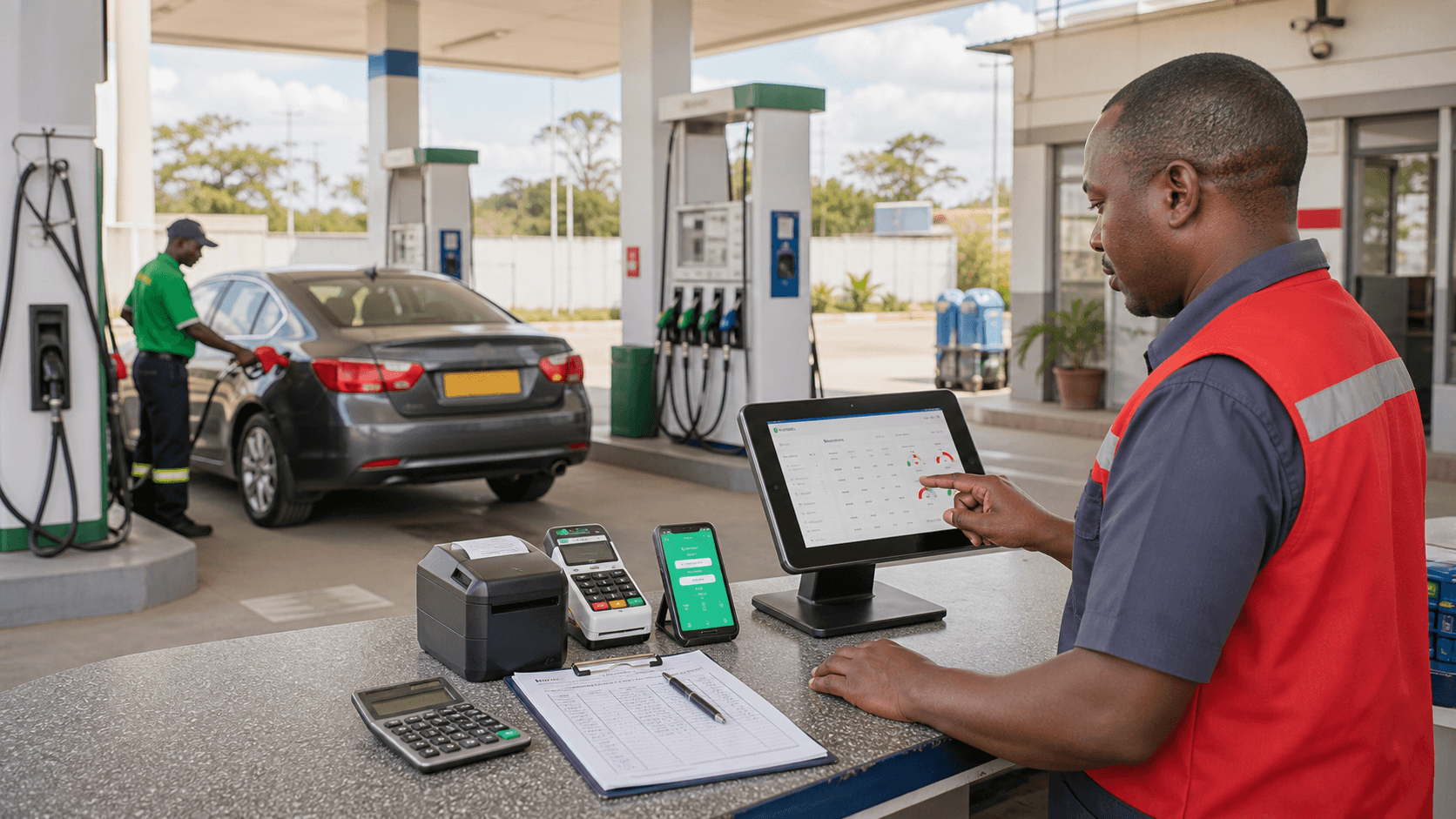
A petrol station in Kenya is a regulated, low-margin, high-shrinkage business where the difference between profit and loss is measured in litres per pump per day, and a 0.5% pump-meter drift costs more than a year of M-Pesa transaction fees. Add a convenience store at the forecourt and you are running two businesses with very different cost structures from one premises. The stations that grow are the ones that reconcile fuel down to the litre every single day, control fleet-card credit, and treat the shop as a profit centre — not an afterthought.
This guide is for petrol station owners and managers in Kenya — independent operators, branded dealers (TotalEnergies, Shell, Rubis, Ola, OilLibya, Hashi Energy and dozens of independent brands), single-site operators and small chains. The operational core is the same.
The Three Tanks That Run Your Business
A standard Kenyan petrol station has three fuel products underground:
- Super petrol (PMS) — the highest-volume sale.
- Diesel (AGO) — sold to trucks, matatus, generators, agricultural customers.
- Kerosene / paraffin — declining but still a regulated product.
Each tank has a capacity (typically 10,000–30,000 litres), a current volume measurable by dipstick, and a stream of dispensing through one or more pumps. Tracking fuel from delivery → tank → pump → sale is the daily discipline of running the business.
Daily Fuel Reconciliation: The Non-Negotiable
Every day, every station, the manager does the fuel reconciliation. The math:
- Opening tank volume (dipstick reading at start of day).
- Plus deliveries received during the day (volumes signed for on delivery notes from KPC or the OMC).
- Equals fuel available.
- Minus closing tank volume (dipstick reading at end of day).
- Equals fuel dispensed.
- Compare to total pump readings (sum of all sales recorded by each pump's mechanical or electronic meter).
The two numbers — "fuel dispensed by tank measurement" and "fuel dispensed by pump readings" — should match within a tolerance of 0.5% or so. Anything bigger and you have a problem: pump miscalibration, theft, dispensing fraud, or a measurement error.
Why the Reconciliation Has To Be Daily
A small daily discrepancy of 50 litres is invisible until it has accumulated to 1,500 litres over a month — at KES 200 per litre that is KES 300,000 of fuel unaccounted for. By the time you notice, you cannot pinpoint which day or which shift it started.
Tracked daily, the discrepancy is small, immediate, and traceable to a specific shift, pump or transaction set. The POS daily fuel report is the manager's most-read document.
Pump Meters and Dispensing Discipline
Every fuel pump records cumulative litres dispensed (its "totaliser"). At shift open and shift close, the attendant or manager reads each pump's totaliser, the POS records the delta as the shift's dispensing volume, and the cash + M-Pesa + card collected for that shift is matched against the dispensed volume at the active selling price.
The Per-Pump Per-Shift Audit
- Opening totaliser: each pump's reading at shift start.
- Closing totaliser: each pump's reading at shift end.
- Volume dispensed: closing − opening.
- Expected revenue: volume × current pump price.
- Actual cash + M-Pesa + card collected.
- Variance: actual − expected.
Variances of more than KES 200–500 per shift trigger a review. Persistent variances on a specific pump or specific attendant trigger an investigation. The POS makes this routine; without it, the math is so tedious that most managers skip it — which is exactly what dishonest attendants count on.
EPRA and Regulated Pricing
Kenya's Energy and Petroleum Regulatory Authority (EPRA) sets the maximum retail price of petrol, diesel and kerosene for each region of the country, updated monthly on the 14th. Stations cannot sell above the EPRA cap; they can sell below if they choose to compete on price.
- EPRA price update — happens monthly. Your POS price list must be updated the moment the new prices take effect. Selling at the old (higher) price even by a few hours past the cutoff is a violation.
- Per-region pricing — Nairobi prices differ from Mombasa, Eldoret, Kisumu, North Eastern. Set your POS to your station's region.
- Margin per litre — the gap between the OMC's wholesale price to you and the EPRA retail cap. Typically KES 4–8 per litre for super petrol. Diesel margins are usually thinner. Convenience-store products fill the margin gap.
Fleet and Fuel-Card Customers
A significant share of station revenue — at some stations more than 60% — comes from fleet customers paying via:
- Fleet cards — Stanbic Fleet, NCBA Fuel Card, Equity Fuel Card, KCB MShwari for SMEs, branded OMC cards.
- Corporate accounts — invoiced monthly, paid by EFT.
- Government and county vehicles — Local Purchase Order (LPO) based.
What the POS Should Track Per Fleet Customer
- Vehicle plate number and driver name.
- Fuel type and litres per transaction.
- Card or account number.
- Driver signature or PIN at the pump (against the card).
- Monthly statement reconciliation.
Fleet sales are reliable revenue but carry credit risk — corporates pay 30–60 days after the fuel is dispensed. The POS aged-receivables report tells you which corporate accounts are paying on time and which are slipping into collection territory.
Shrinkage at a Petrol Station
Petrol station shrinkage takes several forms:
- Pump fraud — attendants under-delivering and pocketing the difference. The cure is meter calibration audits and customer-facing volume displays.
- Cash skim at the till — voiding a sale after the customer leaves and pocketing the cash. The cure is per-attendant PINs and POS-level audit logs on every void.
- Fake M-Pesa confirmations — customer shows a fake "paid" screenshot and drives off. The cure is direct M-Pesa integration in the POS so the payment is verified by the system before fuel is dispensed for unattended customers, or before the receipt is printed for attended customers.
- Tank skimming — fuel deliveries short-delivered by the tanker driver. The cure is dipstick measurement immediately before and after every delivery, signed off by both parties.
- Convenience store theft — same as any retail shop. Cure: CCTV, per-cashier PINs, daily counts of high-shrinkage SKUs.
The Convenience Store: The Real Profit Centre
The shop on the forecourt is where the station actually makes money. Fuel margins of KES 4–8 per litre are tight; convenience store margins of 25–50% on snacks, drinks, household basics and motor accessories are where net profit is generated.
- Hot drinks and snacks — coffee, sausages, samosas, mandazis. Margins 50–70%.
- Soft drinks and water — high turnover, margins 25–35%.
- Tobacco — regulated, lower margin (15–20%), but high foot traffic driver.
- Lubricants — engine oils, ATF, brake fluid. Margins 30–45%.
- Convenience grocery — bread, milk, eggs. Tight margins (10–20%) but a reason for non-fuel visits.
- Car-care — fresheners, wipes, cloths, light bulbs, washer fluid. Margins 35–60%.
FAQ
How often should I dipstick the tanks?
Daily at minimum. Twice daily — opening and closing — is industry best practice. Before and after every delivery is mandatory.
What is an acceptable daily reconciliation variance?
Up to 0.3–0.5% of dispensed volume. Beyond that, investigate. Consistent variance even within that band on the same pump suggests calibration drift.
Do I need a special POS for a petrol station?
Yes — one that integrates with pump controllers, handles fleet card workflows, supports daily fuel reconciliation reports, and connects to your forecourt convenience store seamlessly. Pure-retail POS systems will not handle the volumetric reconciliation that fuel demands.
How do I price fuel below EPRA cap to compete?
You can sell at any price below the EPRA cap. Some stations on busy highways discount KES 1–2 per litre below the cap to win volume; the margin loss is offset by convenience-store attach and pump utilisation.
What happens during an EPRA inspection?
EPRA inspectors verify pump calibration (within 0.5% accuracy), check that posted prices match displayed pump prices, audit fuel quality samples for adulteration, and review your purchase records (deliveries match the OMC's records). Non-compliance ranges from fines to licence suspension.
The Bottom Line
A petrol station is a high-volume, low-margin, heavily-regulated business where small inefficiencies compound into large losses. Daily fuel reconciliation, per-pump per-shift audits, fleet account management, EPRA price compliance, and a profitable convenience store are the five operational disciplines. The POS that supports all five — not the cash register repurposed from a duka — is the system that lets a single station scale into a small chain.
Ready to try DukaSale?
Free POS app for Kenyan dukas. Track sales, inventory, M-Pesa payments, and customer credit — all offline.
Download Free