Car Wash Business in Kenya: Service Tiers, Queue Management, Loyalty and the Add-On Economy
How to run a profitable car wash in Kenya — designing service tiers, managing the vehicle queue, tracking water and chemical consumption, the add-on economy (vacuum, polish, fragrance), and the POS workflow that ties it together.
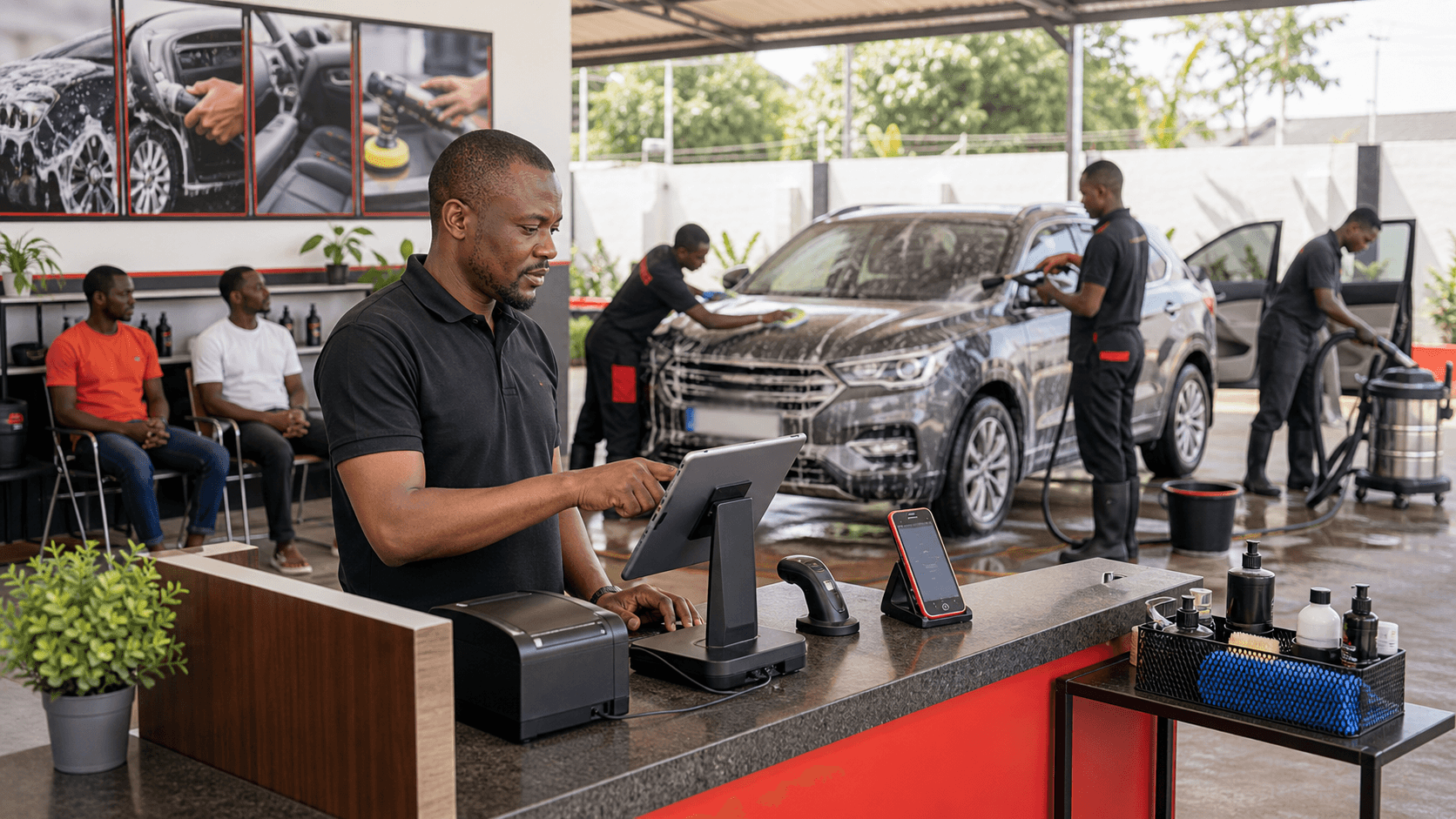
A car wash in Kenya is a high-volume, low-margin service business where the average ticket is KES 300–800 but a busy weekend pushes 80–150 vehicles through a single bay. The economics work only if the queue keeps moving, the service tiers funnel customers toward higher-margin packages, the add-ons (vacuum, polish, fragrance, tire shine) lift the average ticket, and the regulars come back every two weeks. Run it like a one-off transaction and you stay small; run it like a service business with a customer base and you build a brand.
This guide is for car washes across Kenya — the corner-bay washes serving matatu sacco vehicles, the mid-market washes at strip malls and petrol stations, the premium detail-and-polish outfits in Kilimani and Karen, and the mobile wash services that bring the bucket to the customer's compound.
Designing Service Tiers
The biggest mistake new car washes make is offering "a wash" at one price. The biggest leap forward is building a tier ladder that gives customers an obvious upgrade path. A workable tier structure for a Kenyan car wash:
- Basic wash — exterior soap and rinse, light tire clean. 15–20 minutes. KES 200–350.
- Standard wash — exterior wash, interior vacuum, dashboard wipe, mat shake-out. 25–35 minutes. KES 400–600.
- Premium wash — full exterior with wax, full interior vacuum, dashboard polish, glass clean inside and out, tire shine. 45–60 minutes. KES 700–1,000.
- Detail / deep clean — premium plus engine bay wash, undercarriage rinse, seat shampoo, full polish or wax. 2–3 hours. KES 2,000–5,000.
The pricing gap between tiers should feel rewarding. If basic is KES 300 and standard is KES 500, the customer thinks "for KES 200 more I get vacuum and dashboard — yes." If the gap is KES 300 and KES 1,000, they default to basic and you lose the upsell.
The Queue: Where Most Car Washes Lose Money
Queue management is the single biggest operational lever in a car wash. A bay that wash-rinses-dries in 25 minutes can do 16–18 cars in an 8-hour day. If a customer waits 45 minutes before their car is even started, you lose them to the competitor across the road.
The Practical Queue Workflow
- Vehicle arrives. Attendant takes registration plate, customer name and phone number into the POS, assigns the service tier, and gives the customer an estimated ready time.
- The POS queue screen shows every vehicle in process — which bay, what service, expected finish time. Staff can see when capacity opens up.
- Customer waits in the lounge, gets a WhatsApp message when the vehicle is ready (or a SMS, or a simple counter ticket).
- Vehicle moves through the wash, vacuum, drying, finishing stations.
- Quality check by the supervisor before handover.
- Payment at the till. Receipt printed or sent by SMS. Customer collects.
Capacity Math
Plan your bays around realistic throughput, not headline numbers. A two-bay car wash with standard wash as the dominant tier:
- Two bays × 30 minutes per car = 4 cars per hour theoretical.
- Realistic with handovers, queue gaps, and quality checks: 3–3.5 cars per hour.
- 10-hour day: 30–35 cars.
- Average ticket KES 500 = KES 15,000–17,500 daily revenue.
From this you back-calculate staff, water consumption, chemical use, and what tier mix you need to be profitable.
Add-Ons: Where the Margin Lives
The basic wash makes 30–40% gross margin after water, chemicals and labour. The add-ons make 60–85%. The customer who chose a basic wash for KES 300 walks away spending KES 550 if you offer a vacuum (KES 100), a fragrance (KES 50) and a tire shine (KES 100). Same labour time, much better margin.
The Add-Ons That Sell Themselves
- Interior vacuum — KES 100–150. Universal upsell.
- Dashboard polish — KES 50–100. Visible result, easy yes.
- Tire shine — KES 100–150. Vehicle looks like it just came off the showroom floor.
- Fragrance / air freshener — KES 50–100. Small ticket, high margin, near-100% attach when offered.
- Window de-streaking — KES 100. Extra polish that makes a real difference.
- Mat shampoo — KES 200–400. Customers with kids almost always say yes.
- Wax / sealant — KES 500–1,500. The premium upsell.
The POS should prompt the till operator on every basic-wash sale: "Would the customer like to add a vacuum and dashboard polish for KES 150?" Track the add-on attach rate and the average ticket monthly. The discipline pays for itself in three weeks.
The Customer Database: Plate Number as the Key
Car washes are repeat businesses. The same vehicle comes back every 2–4 weeks. The POS customer record uses the plate number as the unique identifier (more reliable than a phone number for a car-cleaning context). Each plate links to:
- Vehicle make, model, colour.
- Customer name and phone.
- Service history with dates, tiers, add-ons, and totals.
- Notes — "leather seats, no wax on the dashboard," "tinted windows," "scratch on rear right — pre-existing."
This is what enables the staff to greet a regular by name, remember preferences, and add value the first-time competitor cannot.
Loyalty: Tenth Wash Free
The car wash loyalty mechanic has barely changed in 30 years because it works. Punch card or POS-tracked, the deal is simple: every tenth wash is free (or 50% off). The POS automatically applies the discount on the qualifying visit.
- Customer benefit — clear, easy to understand.
- Business benefit — locks in 9 visits before the free one, builds habit, reduces defection.
- Margin reality — giving away one wash in ten is a 10% discount on the customer's annual spend. Easily covered by retention.
Layer in birthday discounts, referral credits (KES 200 off when a referred customer completes their first wash), and a "rainy week" promo (20% off when business is slow) and the loyalty program becomes a real revenue lever.
Water, Chemicals and the Inputs Problem
Car washes burn through water (200–400 litres per car) and chemicals (soap, wax, dashboard polish, tire shine, fragrance). Tracking input cost per wash is what separates the profitable wash from the one that "is busy but never has money."
What to Track
- Daily water consumption — meter reading at start and end of day. Compare to cars washed.
- Chemical inventory — soap drums, wax bottles, polish containers. Re-order points set so you never run out mid-shift.
- Cost per wash by tier — basic wash inputs ≈ KES 40–60, premium ≈ KES 100–150. Your POS report should show actual gross margin per tier, not just revenue.
The wash that uses 600 litres per car when 350 is standard is leaking water and money. The one whose wax bottle empties in two weeks instead of four has staff applying triple the needed amount. These leaks add up fast.
FAQ
Do I need to register my car wash business?
Yes — single business permit from your county, KRA PIN, and a water permit / agreement with the local water authority (water consumption matters for licensing). NEMA approval may be required for premises with significant water discharge.
Can I run a car wash on a phone POS?
For small one-bay operations, yes — track plate-number-keyed customers, services, payments and add-ons. For multi-bay or detail operations, a tablet or browser-based POS with a proper queue view is worth the small extra cost.
How do I prevent staff from doing "off-the-books" washes for cash?
Every customer interaction must start with the POS — plate number recorded, ticket issued. If a car is on the bay without a POS ticket, supervision flags it. Daily reconciliation of plate-numbers-washed vs cash-and-M-Pesa-collected catches discrepancies fast.
What is the typical margin on a car wash?
30–40% gross on basic wash, 50–65% on standard, 60–80% on premium and detail. The blended margin lands at 45–55% for a well-run business. After rent, water and labour, net margin is typically 12–20%.
Should I add other services — tire repair, oil change?
Only if you have the space, the trained staff and the customer demand. Many successful Kenyan car washes have evolved into "auto service centres" that include polish, dent removal, light mechanical work and even car-cosmetics retail. Diversification works if you can resource it; otherwise it dilutes focus and slows the queue.
The Bottom Line
A car wash makes money in the gap between basic and premium, between standalone wash and wash-plus-add-ons, between one-time customer and 25-times-a-year regular. A POS that handles queue tracking, plate-number-keyed customer records, tier-based service menus, automatic loyalty rewards and per-staff productivity is the operational system that turns a corner-bay business into a multi-location brand.
Ready to try DukaSale?
Free POS app for Kenyan dukas. Track sales, inventory, M-Pesa payments, and customer credit — all offline.
Download Free